Why Instagram Transcript Tools Stop Working
Start with the tool's input, not its promise
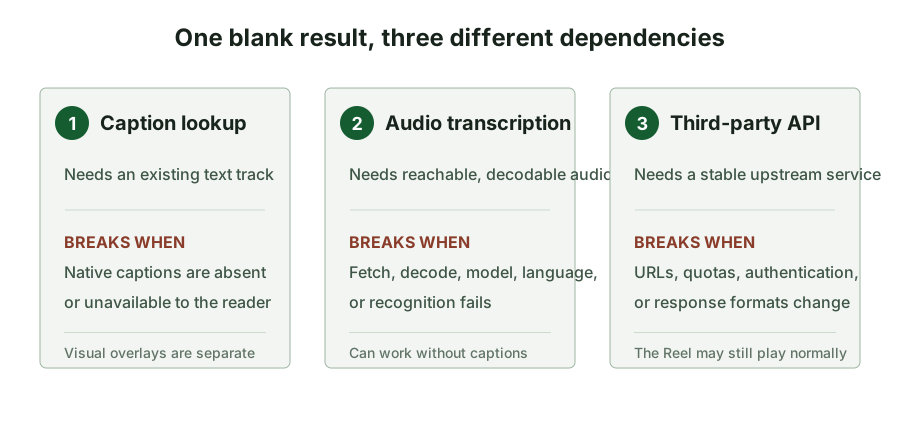
1. Caption lookup
The tool reads a text layer that already exists. It can be fast and inexpensive, but no native caption track means there may be no transcript to return. Words burned into the video frames are a separate visual source.
2. Audio transcription
The tool retrieves sound and runs speech recognition. It can work without native captions, but it adds fetch, decode, model, language, and recognition failure points. Music and overlapping voices can change the draft.
3. Third-party API
The interface sends the link to another service. Availability depends on that provider's accepted URLs, authentication, quotas, and response format. A changed dependency can break the wrapper without changing the Reel.
Diagnose the path you are using
Select the strongest fact you can verify. This checklist does not test a third-party service; it tells you which dependency to investigate next.
Choose one observed signal. Do not infer the path from a blank output alone.
What each failure actually proves
A missing transcript does not prove the Reel has no words. It proves only that the chosen route did not deliver text. A caption-path failure may mean no caption track was available. An audio-path failure may occur before speech recognition starts. An API-path failure may be a quota, URL, authentication, or upstream-format problem. Those explanations are alternatives; a blank result cannot distinguish them.
Use visible evidence. Look for wording such as “extract captions,” a status that mentions fetching or processing audio, a browser model download, a documented credit charge, or a network error exposed by the tool. If the method stays hidden, treat it as unknown. Retrying is reasonable after a temporary interruption, but repeated attempts do not reveal an undisclosed architecture.
The XAPN path we have actually checked
XAPN is an audio-first tool. Its checked workflow sends a public Reel link to POST /audio, decodes the returned audio in the browser, initializes Xenova/whisper-tiny.en, and places recognized English text in the result area. That path does not import Instagram's native caption track. The transcript can therefore be attempted when native captions are absent, provided the audio is reachable and contains intelligible speech.
This distinction is based on the site's served code and a previously recorded public-example audio response. It is not a success-rate claim. XAPN has also recorded a same-link failure and retest: the first run stopped during audio retrieval because the service environment lacked a download dependency; after that dependency was restored and the service restarted, the same link reached a nonempty result. The recognition still contained errors. That observation shows why “the link is bad” is not the only explanation for an empty transcript.
Boundary: we did not test or rank every Instagram transcript service for this article. We do not claim that all caption tools, all APIs, or all audio-first tools fail in the same way. The three-path model is a diagnostic framework; XAPN's own audio path is the only implementation described here as inspected.
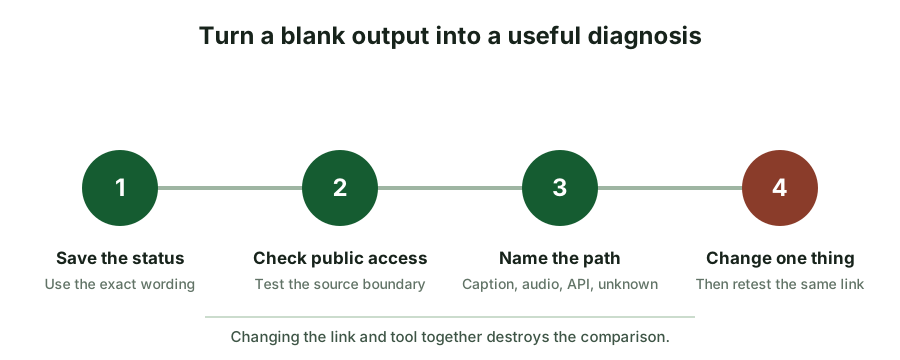
A disciplined retry sequence
- Save the exact status. “It failed” is too vague. Record whether the interface was fetching, decoding, loading a model, transcribing, or waiting on an external response.
- Confirm the source boundary. Open the Reel as a public visitor. A private, removed, restricted, or unreachable source cannot be repaired by changing transcript formatting.
- Name the path. Decide whether the tool depends on captions, audio, an external API, or an undisclosed method.
- Change one dependency. For a caption reader, choose a Reel with confirmed native captions or move to an audio-first path. For audio transcription, fix the failed fetch, decode, model, language, or recognition stage. For an API wrapper, check the provider's current acceptance and quota.
- Retest without rewriting the evidence. Keep the same public link when possible. A changed link and changed tool at the same time cannot show which change mattered.
When to stop retrying
Stop when the route cannot obtain its required input. A caption extractor cannot create a missing caption track. An audio recognizer cannot hear a silent Reel or retrieve private media. A wrapper cannot repair an unavailable provider from the visitor's browser. At that point, change the data path: manually review visible text, use reachable audio with speech recognition, or obtain an authorized source file.
For a failure inside XAPN, use the stage-by-stage failure guide. To understand captionless input, read the checked audio-versus-caption path. If you need to preserve words that appear only on the frames, use the source-labelled video text worksheet instead of silently calling them speech.
Questions
Why does one Instagram transcript tool work when another returns nothing?
They may use different inputs. A tool that reads native captions and one that recognizes audio do not fail at the same boundary.
Does a blank result mean the Reel has no captions?
No. It may mean captions are absent, audio retrieval failed, recognition returned no words, or an external dependency rejected the request. The blank result alone is not diagnostic.
Should I keep pasting the link into new tools?
Only after identifying a different path. Five interfaces built on the same missing caption layer or unavailable endpoint can fail for the same reason.