Instagram Transcript Checker
Check a transcript in your browser
Your text stays in this page. Nothing is uploaded by this checker.
Review findings
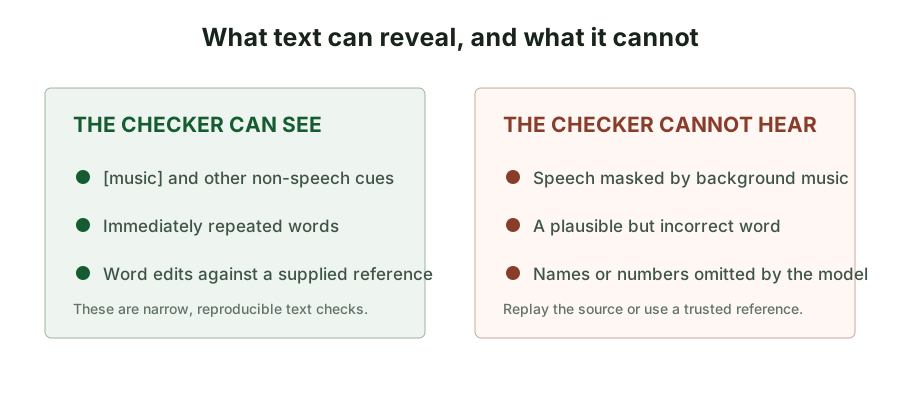
What the checker measures
The first count is simply the number of word tokens in the draft after punctuation and letter case are ignored. Visible warnings cover two narrow patterns: bracketed or parenthesized non-speech cues such as [music], and words repeated immediately next to themselves. Those warnings are not proof of a bad transcript. A cue may be useful, and a speaker may genuinely repeat a word.
When a reference is supplied, the checker uses word-level Levenshtein distance. That is the smallest number of insertions, deletions, and substitutions needed to transform the draft into the reference after case and punctuation are normalized. The result is an edit count, not an accuracy percentage. A draft can require more edits than the reference contains because inserted words also count.
Privacy boundary: the checker runs in the current page and does not submit either text to XAPN. The site still loads its ordinary analytics script. Reloading the page clears the entered text.
What happened with XAPN's music-heavy sample
The sample button loads two texts already published in XAPN's controlled music test: the 15-word reference sentence and the raw output from the same Whisper tiny English model at a speech-to-music RMS ratio of -40 dB. The speech was quieter than the artificial music bed. Running the checker returns 16 word-level edits. That number is reproducible from the displayed strings; it is not a claimed average for Reels.
| Input | Observed result | What it establishes |
|---|---|---|
| Clean voice stem | 0 word-level edits | The model matched all 15 reference words in this one controlled input. |
| Voice plus music at -35 dB | 1 word-level edit | The final reference word “Friday” became “writing.” The sentence still looked plausible. |
| Voice plus music at -40 dB | 16 word-level edits | Substitutions and insertions no longer preserved the sentence reliably. |
The crucial result is the -35 dB line. A structural checker cannot know that “writing” should have been “Friday” unless a trusted reference is present. The output is grammatical enough to pass a quick visual scan. That is why a music-heavy transcript still needs to be replayed against the actual speech.
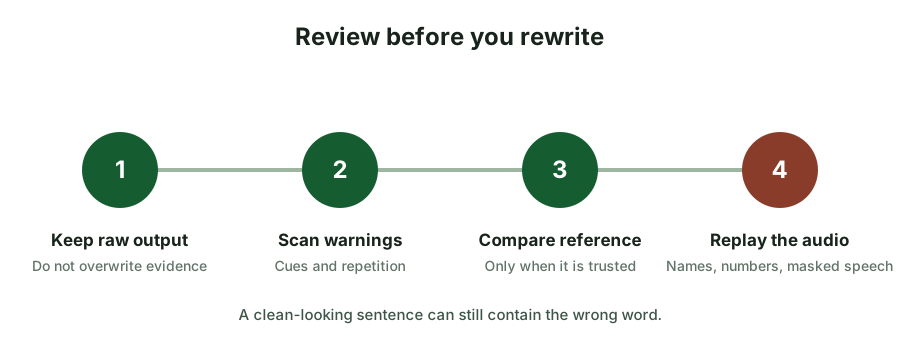
Use the result without overstating it
- Preserve the raw draft. Paste it before changing punctuation or wording. Otherwise the checker measures your edit, not the generator output.
- Read every visible warning in context. Remove a cue only if you do not need it. Keep an intentional repeated word when the speaker actually repeats it.
- Add a reference only when it is trusted. A creator script, a careful manual transcription, or a known test sentence can serve as a reference. Another automatic transcript cannot certify the first one.
- Replay what text alone cannot settle. Check names, numbers, calls to action, direct quotations, and phrases covered by music or another voice.
- Save the reviewed version separately. Keep the model output and the corrected text as two different records.
Why this is not a background-music remover
XAPN's generator retrieves Reel audio, decodes it, resamples it to one 16 kHz channel, and passes that waveform to Xenova/whisper-tiny.en. There is no separate source-separation stage in the checked path. This page begins after words already exist, so it cannot reconstruct a clean vocal stem or recover speech that the model omitted.
A text cleanup button that silently deletes odd phrases would be worse than an honest warning: it could remove spoken words while leaving a plausible substitution untouched. This checker therefore reports narrow signals and measured differences, but leaves editorial decisions to the person who can hear the source.
Test boundary: XAPN tested one synthetic English sentence, one lyric-free artificial tone pattern, one model, and three music levels. We did not test or rank every Instagram transcript service, and we did not submit these samples to SpeakApp, GetTheScript, Eden, or another competitor. The sample results do not establish a general music threshold or product accuracy rate.
Questions
Can the checker remove words created by background music?
No. It can flag a few visible patterns, but a plausible wrong word may look completely normal. Compare it with the audio or a trusted reference.
Why is the edit count not an accuracy score?
It counts the minimum word changes between two specific texts. It does not weight important words differently, prove which source is correct, or generalize beyond that pair.
Where do I generate the transcript first?
Use the Instagram transcript generator for one reachable public English Reel, then paste the untouched output here. For the downloadable audio and full method behind the sample, read the controlled music stress test.